


ANIPH presents LCA framework for bio-based materials at Maastricht Symposium
The Agricultural University of Athens shared ANIPH's modular life-cycle assessment approach for bio-based materials at the 7th Symposium on Circular Economy and Sustainability.
How can early-stage environmental assessment of PHA-based materials, formulations and products be strengthened by explicitly integrating circular economy and Safe-and-Sustainable-by-Design principles?
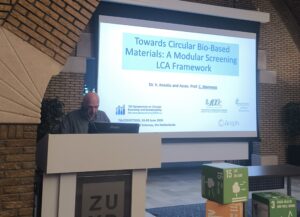
This was the question at the heart of a presentation delivered by our partner, the Agricultural University of Athens, at the 7th Symposium on Circular Economy and Sustainability, held on 25 June.
Titled “Towards Circular Bio-Based Materials: A Modular Screening LCA Framework”, the talk introduced a modular, screening-level life cycle assessment framework for emerging bio-based materials, developed within the ANIPH project. The results revealed two distinct environmental profiles: PHBV-based systems were primarily associated with Climate Change and Fossil Resource Use impacts, while PHN-based systems showed higher Water Use and Freshwater Ecotoxicity burdens.
Hotspot analysis offered actionable guidance for future optimisation and showed how environmental burdens can be traced across the value chain. Overall, the framework provides a robust basis for industrial validation and more detailed LCA studies, supporting the sustainable development of next-generation bio-based materials.
The conference, held in Maastricht from 24 to 26 June, focused on circular economy research, covering topics such as industrial symbiosis, sustainable business practices, resource efficiency, SME sustainability transitions, and policies tied to the EU’s circular economy goals. It brought together expertise in engineering, management, business economics, and sustainable international business, combining theoretical, practical, applied, and managerial perspectives to advance effective circular economy strategies and policies.
Against this backdrop, ANIPH stands out as one of the most innovative initiatives applying bio- and circular economy principles to healthcare, developing advanced bioplastics for fully biodegradable wound dressings and packaging.
Photo by Sincerely Media on Unsplash